Best Time to Buy a Sofa: The Complete Seasonal Shopping Guide
Timing your sofa purchase can save you hundreds of dollars. Learn exactly when retailers drop prices, which holidays offer the deepest discounts, and how to plan your buying strategy like a pro.
BROWSE TOP-RATED SOFASWhy timing matters: A quality sofa is one of the most significant furniture investments you'll make, typically ranging from a few hundred to several thousand dollars. The exact same model can cost dramatically different prices depending on when you buy it. Understanding the furniture industry's sales cycle empowers you to avoid overpaying and walk away with the best possible deal on a sofa that fits your home, lifestyle, and budget.
The Short Answer: When Is the Best Time?
If you need a quick answer before diving into the details: the two best windows to buy a sofa are January through February and late June through July. These periods align with post-holiday inventory clearances and mid-year seasonal transitions, when retailers are most motivated to move stock. Among specific sale events, Presidents' Day, Memorial Day, Fourth of July, Labor Day, and Black Friday/Cyber Monday consistently deliver the steepest discounts across both online and physical stores.
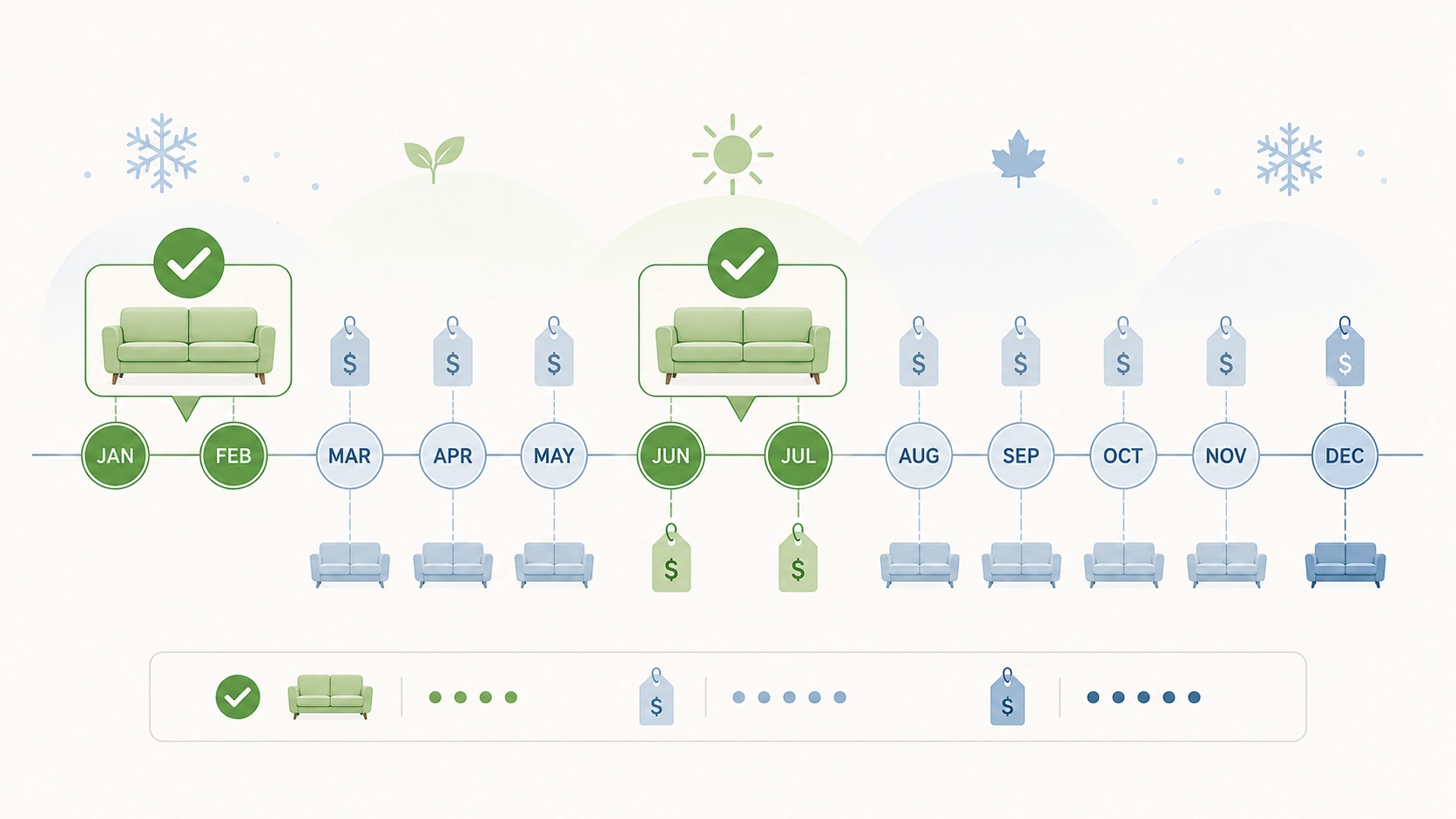
However, the "best" time also depends on factors like your budget, whether you have a specific model in mind, and whether you're shopping online or in-store. The sections below break down every factor so you can make a confident, well-timed decision.
Month-by-Month Sofa Buying Calendar
The furniture industry follows a predictable sales cycle driven by seasonal design releases, inventory turnover, and major retail holidays. Here is a complete month-by-month breakdown of what to expect when shopping for a sofa.
| Month | Savings Potential | What to Expect |
|---|---|---|
| January | Post-holiday clearance in full swing. Retailers clearing inventory for spring collections. Discounts of 40-60% on previous year's models. | |
| February | Presidents' Day sales (mid-month) are among the top 3 furniture sale events. Excellent selection with deep discounts. | |
| March | Spring collections arriving. Remaining clearance items drop further, but selection narrows. Decent time for floor model deals. | |
| April | New inventory at full price. Fewer sales unless you catch a spring promotion. Not ideal for bargain hunters. | |
| May | Memorial Day weekend kicks off the summer sale season. Strong discounts, especially on outdoor and indoor living room sets. | |
| June | Mid-year clearance begins as retailers prepare for fall inventory. Gradually increasing discounts throughout the month. | |
| July | Fourth of July sales rival Presidents' Day. Massive clearance on spring/summer inventory. One of the best buying windows. | |
| August | Back-to-school and dorm furniture sales benefit apartment-size sofas. Full-size sofa deals taper off but remain available. | |
| September | Labor Day weekend is a major sale event. Retailers push to clear summer stock before fall collections take over showrooms. | |
| October | New fall inventory at full price. Limited sales. Some retailers run early Black Friday previews late in the month. | |
| November | Black Friday and Cyber Monday deliver the most advertised deals. Doorbuster pricing on select models. High competition among retailers. | |
| December | Pre-holiday prices are high. Post-Christmas clearance (after Dec 25) can yield surprises, but selection is unpredictable. |
Top Holiday Sale Events for Sofa Shopping
Not all sale events are created equal. Some holidays deliver genuine savings while others are primarily marketing hype. Here are the five most impactful sale events for sofa buyers, ranked by their typical discount depth and selection quality.
Presidents' Day
February (3rd Monday)Often called the "hidden gem" of furniture sales. Retailers compete aggressively during this long weekend because it falls during the deepest inventory clearance period. Wide selection of discounted models from the previous year.
30% – 55% OFFMemorial Day
May (Last Monday)Kicks off the summer sale season with strong promotions across all furniture categories. Particularly good for sectional sofas and living room sets. Many retailers offer free delivery bonuses.
25% – 50% OFFFourth of July
July 4th WeekendOne of the strongest mid-year sale events. Retailers need to clear spring and summer inventory before fall collections arrive. Excellent for both in-store and online purchases with deep sitewide discounts.
30% – 55% OFFLabor Day
September (1st Monday)The last major sale before the holiday season. Good balance of selection and discounts. Ideal if you missed the July window. Often paired with financing offers like 0% interest for 12-24 months.
25% – 45% OFFBlack Friday / Cyber Monday
November (4th Thursday + following Monday)The most aggressively advertised sales of the year. Doorbuster deals on specific models can be exceptional, but quantities are limited. Cyber Monday is especially strong for online-only retailers like Wayfair and Amazon.
40% – 65% OFF (select models)Amazon Prime Day
July (Variable dates)A key event for online sofa shoppers. While not a traditional furniture sale holiday, Prime Day features significant discounts on sofas sold through Amazon, including many top-rated budget-friendly options.
20% – 45% OFFWhy the Furniture Industry Discounts on This Cycle
Understanding the business logic behind these sales helps you shop smarter. Furniture retailers operate on a seasonal model similar to the fashion industry, and their pricing strategy is driven by three key factors.

1. Seasonal Collection Turnover
Most furniture brands release two major collections per year: spring (February–April) and fall (August–October). When new designs arrive in showrooms, the previous season's inventory must be cleared to make space. This creates natural discount windows in January–February (before spring arrivals) and June–July (before fall arrivals). The sofas being discounted are not defective or lower quality — they are simply from the previous design cycle, which for most classic styles means virtually no visible difference.
2. Retail Floor Space Economics
Physical showrooms have limited square footage. Every floor model represents tied-up capital. Retailers are highly motivated to sell existing inventory before new shipments arrive because unsold stock may need to be stored in warehouses (costing money) or sold to liquidators (at a loss). This urgency translates directly into better prices for you during transition periods.
3. Consumer Spending Patterns
January and February are historically the slowest months for furniture sales because consumers are recovering from holiday spending. Retailers counter this slump with aggressive promotions to generate revenue. Similarly, the period between summer and back-to-school season sees lower foot traffic, making July an ideal time for clearance events.
Online vs. In-Store: Different Sale Schedules
Where you shop matters as much as when. Online retailers and physical stores follow different pricing calendars, and understanding these differences can help you choose the right channel for your purchase.
Online Retailers
- Major sales during Amazon Prime Day, Cyber Monday, and sitewide flash sales
- More frequent but smaller discounts (15-30%) year-round
- Price matching algorithms adjust daily based on competition
- Best for: specific models, comparison shopping, finding niche brands
- Coupon codes and email sign-up discounts often stack with sale prices
- Easier to track price history using tools like CamelCamelCamel for Amazon
Physical Showrooms
- Peak discounts during holiday weekends (Presidents' Day, Labor Day, Black Friday)
- Floor model clearance available year-round (ask a sales associate)
- Negotiation possible, especially on display models or bundle purchases
- Best for: testing comfort, seeing fabric colors in person, evaluating build quality
- Free delivery and assembly often included in sale promotions
- Financing offers (0% APR) more commonly available in-store
A smart strategy is to test sofas in a physical store during a non-sale period, identify the exact model and configuration you want, then wait for the next major sale event to purchase it online — often at a lower price than the store's sale price. Just make sure you're comparing the exact same SKU, including fabric type and color, as different materials can have different pricing.
When You Should Avoid Buying a Sofa
Knowing when not to buy is just as valuable as knowing the best times. Purchasing during these periods almost always means paying a premium with little to no added value.
March–April and October–November (before Black Friday): These are launch windows for new collections. Retailers showcase fresh inventory at full retail price, and discounts are minimal because demand is highest. If you shop during these months, you're paying a premium for the novelty of being among the first to own the latest designs — which is rarely worth the extra cost for a piece of furniture you'll own for years.
Additionally, avoid the pre-holiday rush (early to mid-December) when retailers know customers are desperate to furnish their homes before holiday gatherings. Prices actually increase during this window in many cases. The week between Christmas and New Year's can offer surprise deals, but selection is unpredictable — you may find excellent prices on floor models, but the exact sofa you want might already be sold out.
How to Prepare for a Sofa Sale
Walking into a sale unprepared is a recipe for impulse buying. Follow this step-by-step preparation guide to ensure you're ready to act decisively when prices drop.
- Measure your space precisely — Use our sofa measuring guide to record your room dimensions, doorways, hallways, and any obstacles. There's nothing worse than finding a great deal on a sofa that won't fit through your front door.
- Determine your budget range — Understanding how sofa prices break down helps you recognize a genuine deal versus a marketed discount on an overpriced item. Factor in delivery, taxes, and potential accessories.
- Identify 2-3 target models — Don't fixate on a single sofa. Research multiple options across different retailers so you have flexibility when sale inventory fluctuates. Bookmark product pages and note the regular (non-sale) price.
- Sign up for retailer email lists — Most major furniture retailers send early access notifications to subscribers 24-48 hours before public sales begin. This head start can mean the difference between securing your chosen model and finding it sold out.
- Check price history — For online purchases, use price tracking tools to verify that the "sale price" is actually lower than the recent historical average. Some retailers inflate original prices before applying discounts.
- Read recent reviews — Sale pressure can lead to skipping research. Make sure your target sofa has consistent positive feedback on comfort, durability, and delivery experience before committing.

Hidden Costs That Can Erode Your Sale Savings
A 50% discount means nothing if you're hit with unexpected charges that eat into your savings. Be aware of these common add-ons that can turn a great deal into an average one.
Delivery and shipping fees are the most common surprise. Some retailers advertise a low sofa price but charge $150–$400 for delivery, especially for heavy items like sectional sofas or recliners. Always confirm the total delivered price before comparing deals. Many holiday promotions include free delivery, which can itself be worth $200+ in savings.
Fabric upgrades can silently increase your price. The sale price you see is often for the base-grade fabric. Upgrading to performance fabric, leather, or a premium upholstery can add $200–$1,000 to your total. If you're choosing between a leather vs. fabric sofa, make sure you're comparing the final price for your preferred material, not just the base configuration.
Protection plans and fabric treatments are aggressively upsold at checkout. While sofa protection has genuine value, these add-ons are frequently overpriced. You can often purchase equivalent third-party fabric protectants for a fraction of the cost. For more details on where your money actually goes, review our guide to hidden costs of buying a sofa.
When comparing deals across retailers, always calculate the "total out-the-door cost" — the sofa price plus delivery, taxes, and any required accessories. A sofa that's $100 cheaper but charges $200 more for delivery is not the better deal. Create a simple spreadsheet with columns for: base price, fabric upgrade cost, delivery fee, tax, and total. This eliminates guesswork and prevents emotional decision-making.
Buying Strategies for Specific Situations
The "best time" varies depending on your unique circumstances. Here's targeted advice for common buying scenarios.
You Need a Sofa Immediately
If you can't wait for a seasonal sale, you still have options. Check where to buy sofas for retailers that run frequent promotions. Look for floor model sales, open-box deals on Amazon or Wayfair, outlet stores, and secondhand vs. new sofa marketplaces like Facebook Marketplace or Craigslist. Floor models can offer 20-40% off with minimal wear, and many come with the same warranty as new units.
You're Buying a Custom or Made-to-Order Sofa
Custom sofas don't follow the same clearance cycle because they're built to order. However, many custom furniture makers offer promotional pricing during major holidays — particularly Presidents' Day and Black Friday — on their standard configurations. The best approach is to contact the manufacturer directly and ask about upcoming promotions. Some will honor a sale price if you place your order within a few weeks before or after the event.
You're Shopping for a Specific High-Demand Model
Popular models like the cloud couch or trending modern sofas may never see deep discounts because demand consistently outpaces supply. For these, the strategy shifts from "wait for the lowest price" to "buy at the first reasonable discount." Set a target price (typically 15-20% off retail) and pull the trigger when you see it, rather than holding out for 40% off that may never come.
You're Furnishing on a Tight Budget
Budget shoppers should prioritize timing above all else. A quality budget sofa during a Presidents' Day or Black Friday sale can cost the same as a lower-quality model at regular price. Also consider that 2-seater sofas and loveseats typically see deeper percentage discounts than large sectionals because their lower price point makes them less profitable for retailers to hold in inventory.
Can You Negotiate Sofa Prices During a Sale?
Yes — and you should. Even during advertised sale events, there's often additional flexibility that most shoppers don't realize exists. Here's how to approach negotiation effectively.
- Ask about floor model pricing — even if it's not displayed, many stores will offer an additional 15-25% off the sale price for the display unit
- Request free delivery if it's not already included — this is the easiest concession for sales associates to make and can save $150-400
- Inquire about bundle discounts if you're purchasing a sofa with matching pieces like an ottoman or accent chairs
- Ask if they can match a competitor's price — bring screenshots of lower prices from other retailers, especially online ones
- Check for open-box or slightly damaged inventory — minor cosmetic flaws that are barely noticeable can mean 20-30% additional savings
- Don't be afraid to walk away — if the deal isn't right, leaving your contact information often prompts a follow-up call with a better offer within a few days
Remember that sales associates typically work on commission and have monthly quotas. Shopping at the end of the month — especially the last few days — gives you additional leverage because salespeople are more motivated to close deals. For more detailed guidance on evaluating what you're actually getting for your money, read our guide on how to check sofa quality before buying.

Avoiding the "Sale Trap": Quality Shouldn't Suffer
The biggest risk during sale events is buying a low-quality sofa simply because the price looks attractive. A $300 sofa that lasts two years is a worse investment than a $800 sofa that lasts ten years. Understanding the relationship between price and quality is essential for making a smart purchase.
During sales, pay extra attention to these quality indicators:
Frame construction: A quality sofa frame should be made from kiln-dried hardwood, not particleboard or softwoods. Even at 50% off, a sofa with a weak frame is not a good deal. Learn what to look for in our sofa frame materials guide.
Cushion fill: High-density foam with a down or fiber wrap provides the best balance of comfort and longevity. Cheap foam flattens quickly, and you'll notice sagging within months. Our cushion fill types guide explains what to ask for.
Fabric durability: Check the Martindale rub test rating for fabric sofas. A rating below 15,000 rubs will show wear quickly, even in a low-traffic home. For households with kids or pets, look for 30,000+ rubs.
If a sale price seems too good to be true, it probably is. Some retailers create "fake sale" pricing by inflating the original MSRP, making the discount appear larger than it actually is. Always cross-reference prices across multiple retailers and check third-party review sites to verify you're getting genuine value.
Frequently Asked Questions
Quick-Reference Summary
Best Months: January, February, July
Best Holidays: Presidents' Day, Fourth of July, Black Friday
Avoid: March–April, October (pre-Black Friday), early December
Best for Online: Amazon Prime Day, Cyber Monday
Best for In-Store: Presidents' Day weekend, Labor Day, floor model clearance
Preparation Lead Time: 4–6 weeks before target sale
Key Rule: Never buy at full price — there's always a sale within 6 weeks
Timing is just one piece of the puzzle. To make the most informed purchase possible, explore our comprehensive sofa buying guide for everything from measuring your space to evaluating build quality. And when you're ready to shop, browse our top-rated sofa recommendations to find models that deliver excellent value at any price point.